

AT REGISTRATION


PFC 1(C)(I)(b)(i) · Regulation (EU) 2019/1009

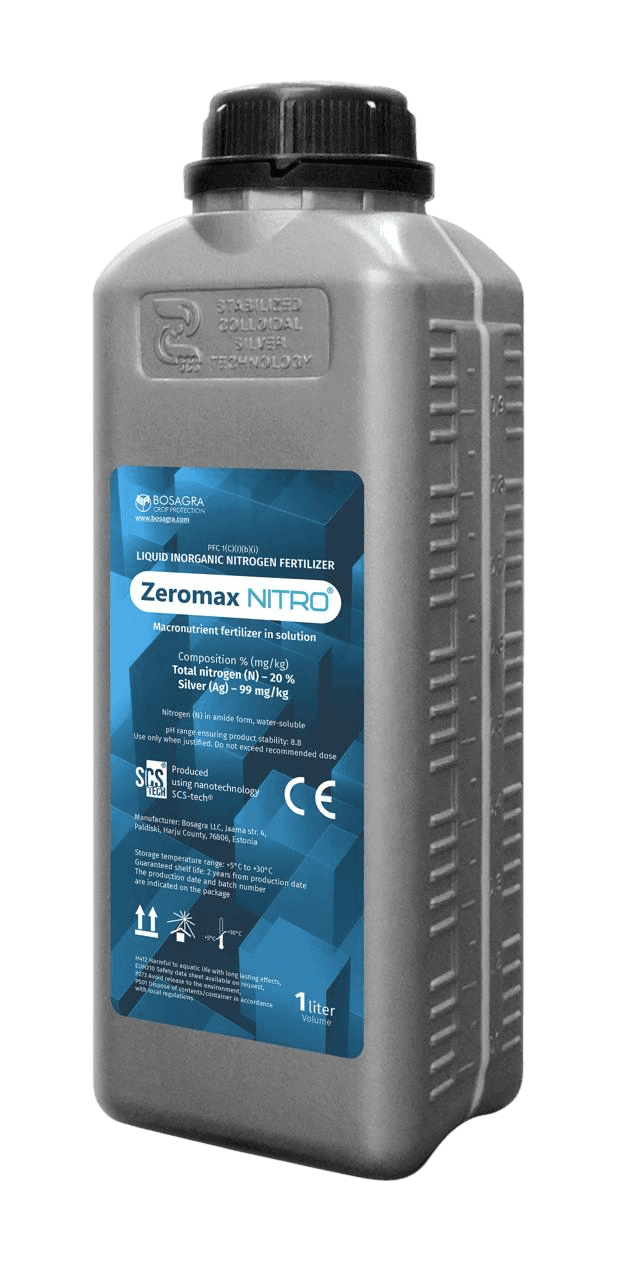
LIQUID INORGANIC NITROGEN FERTILIZER WITH STABILIZED SILVER NANOCOMPOSITE (SCS-TECH®)

MAIN INGREDIENTS:

Total Nitrogen (N) — 18%

i

Silver (Ag) — 0.01%

i

PRODUCT POSITIONING:

Zeromax NITRO® is a foliar nitrogen fertilizer engineered around two principles: controlled nitrogen release and elicitor-mediated immune priming. The amide-N carrier is held in a stabilized matrix that suppresses premature hydrolysis and ammonia volatilization, while the SCS-Tech® silver nanocomposite engages the plant's innate immune cascade. Where conventional foliar nitrogen delivers a short pulse followed by losses to volatilization, Zeromax NITRO® delivers a metered nitrogen profile aligned with the plant's actual uptake kinetics.
THE PROBLEM WITH CONVENTIONAL FOLIAR NITROGEN

Amide and ammonium foliar formulations lose a significant fraction of applied nitrogen to NH₃ volatilization within hours of application, particularly under warm, low-humidity conditions. The remaining fraction enters the plant as a metabolic spike — followed by a depletion phase. The result is uneven growth, inconsistent grain protein, and lower nitrogen use efficiency.

MODE OF ACTION — ENGINEERED CASCADE

  1. Stabilized nitrogen release

    The SCS-Tech® stabilizer matrix forms a transient complex around the amide-N molecule. This:
    • suppresses urease-mediated hydrolysis on the leaf surface;
    • minimizes NH₃ loss to the atmosphere;
    • extends the plant-available window of nitrogen to 10–14 days;
    • raises functional nitrogen use efficiency (NUE) of the foliar application toward the upper range reported for stabilized-N technologies.

  2. Stabilized silver nanocomposite — immune elicitor


    The SCS-Tech® nanocomposite engages the same cascade as Zeromax BOR®:

    Stabilized silver nanocomposite recognized at the cell membrane

    Controlled apoplastic ROS burst

    MAPK signaling activated → SA/JA pathways

    SAR (Systemic Acquired Resistance) + ISR (Induced Systemic Resistance)

    PR-proteins · phytoalexins · reinforced cell walls

    Primed defense state — sustained metabolism under abiotic stress


The result is a plant that converts nitrogen into biomass and yield more efficiently, and that does so even when temperature swings, humidity drops or pathogen pressure would normally cause a metabolic shutdown.

DEMONSTRATED AGRONOMIC EFFECTS

  • Sustained nitrogen supply — no peak-and-crash metabolism
  • Stronger root system and leaf area development
  • Higher chlorophyll index and photosynthetic continuity under stress
  • Improved protein accumulation in grain and oilseed crops
  • Lower risk of foliar burn at recommended rates
  • Reduced atmospheric NH₃ emission per kg N applied

CROP YIELD RESPONSE (VS. UNTREATED CONTROL)

Crop groupObserved yield response
Cereals (wheat, barley, etc.)+10–18%
Corn+12–20%
Oilseeds (sunflower, rapeseed, flax)+10–18%
Potato, vegetables+12–20%
Pome and stone fruits, grape+8–15%
Sugar beet+10–18%
Cotton+10–18%

Ranges based on multi-season field observations; final values per region to be confirmed by your trial dataset.

APPLICATION RECOMMENDATIONS

CropGrowth stageRateSpray volumeApplications
CerealsTillering → stem extension1.0–1.5 L/ha150–300 L/ha1–2
CornV6–V101.5–2.0 L/ha150–300 L/ha1–2
Oilseeds6–8 leaves, budding1.0–2.0 L/ha150–300 L/ha1–2
Potato, vegetables, fruit cropsVegetation, pre/post-flowering1.0–2.0 L/ha300–600 L/ha1–3

Compatible with most plant protection products and foliar fertilizers. Jar test recommended with strongly alkaline solutions or concentrated phosphites.